
When furniture factories ask me whether they should choose 20mm cabinet frame aluminum profiles or 45mm cabinet frame systems, I always explain that the aluminum profile itself is only one part of the final cabinet structure. In real furniture production, the long-term stability, installation efficiency, and door performance depend heavily on how the accessories are matched together. After years of manufacturing furniture aluminum profiles, I have found that many factories focus mainly on profile thickness and surface finish while ignoring corner brackets, connectors, rubber strips, and hinges. In reality, these accessory details are often the reason why some cabinet frame systems remain stable for years while others quickly develop assembly or door sagging problems.
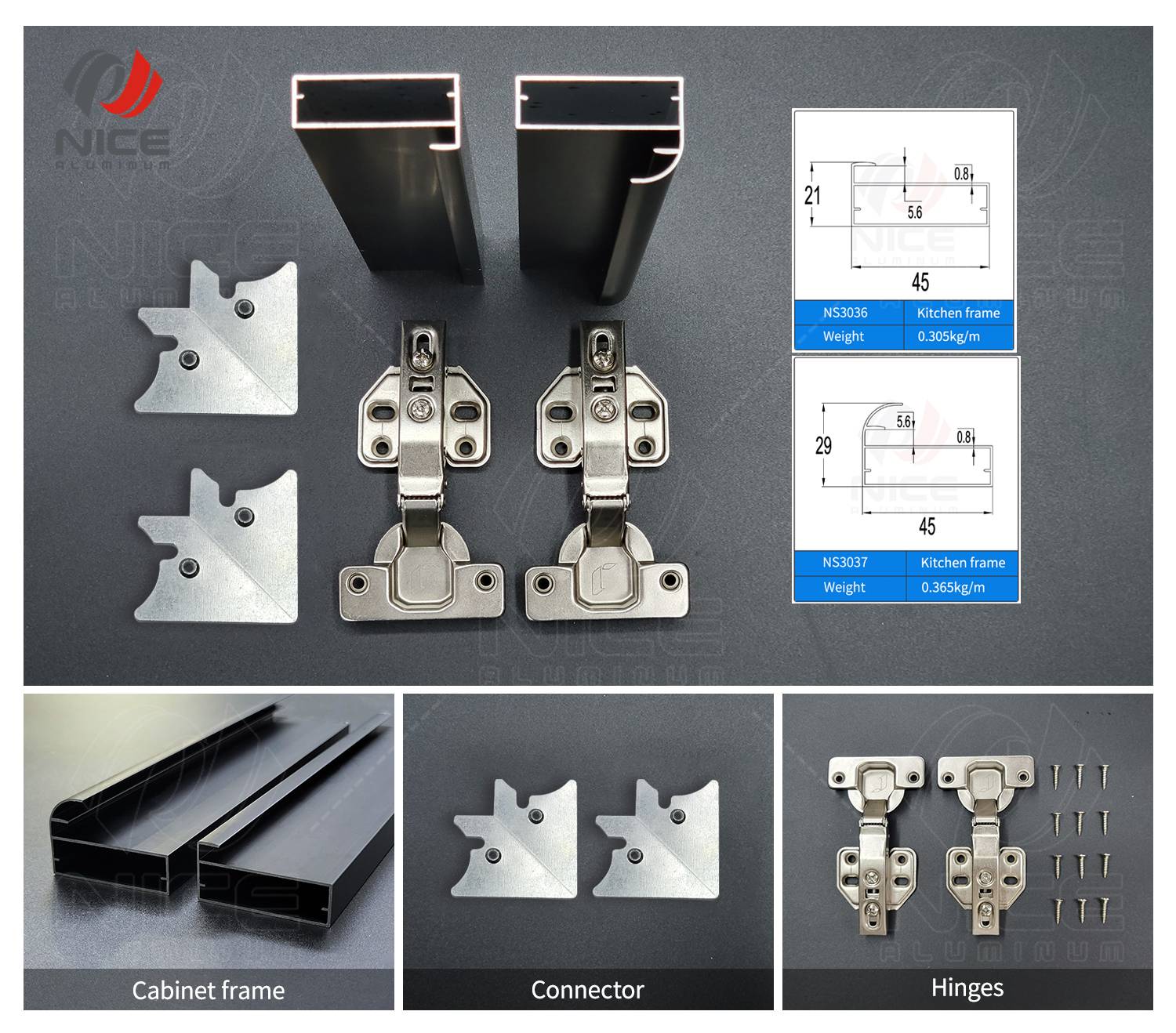
1. The Main Difference Between 20mm and 45mm Cabinet Frame Systems
From my experience, 20mm cabinet frame aluminum profiles are mainly used for slim modern cabinet doors, display cabinets, and lightweight glass furniture systems where minimalist appearance is important. The narrow visible frame creates a clean modern design that many high-end furniture brands prefer today. However, because the overall structure is smaller and lighter, accessory precision becomes much more important.
In contrast, 45mm cabinet frame systems are usually designed for wardrobes, tall cabinet structures, heavy glass doors, and high-frequency opening applications where structural strength matters more than minimal appearance. The larger profile cavity provides stronger support for hinges and reinforced connectors.
One common mistake I often see is that some factories use slim 20mm systems with oversized hinges or thick heavy glass panels, which eventually causes deformation or instability problems. At the same time, some factories use 45mm systems for lightweight decorative furniture, which unnecessarily increases production cost and weight. In my opinion, the correct cabinet frame system should always match the glass thickness, door weight, opening frequency, and installation environment.
2. What I Pay Attention To When Selecting Corner Brackets
Corner brackets directly affect cabinet frame rigidity and long-term assembly stability. When I evaluate corner brackets for furniture aluminum profiles, I mainly focus on wall thickness compatibility, screw locking depth, machining precision, and anti-loosening performance.
For slim 20mm cabinet frame systems, I usually recommend compact hidden corner brackets because oversized structures can deform the narrow aluminum cavity or leave visible marks on the profile surface. For 45mm cabinet frame systems, reinforced heavy-duty corner brackets are usually more suitable, especially for tall cabinet doors or thick glass applications.
One issue many factories underestimate is that even when the aluminum extrusion itself is accurate, poor corner bracket precision can still create assembly problems such as frame twisting, unstable glass positioning, or door misalignment.
3. Connector Selection Is More Important Than Most Factories Think
In many furniture projects, connectors directly determine assembly efficiency and production consistency. In our factory projects, I usually divide cabinet frame connectors into fast assembly connectors, hidden connectors, reinforced structural connectors, and adjustable positioning connectors.
For export furniture factories, assembly speed is extremely important because installation efficiency directly affects labor cost. A poorly matched connector system can increase assembly time and create fitting inconsistencies during production.
For slim 20mm cabinet frame aluminum profiles, I normally recommend hidden connector systems because visible connectors damage the minimalist appearance. For 45mm cabinet frame systems, reinforced connectors are often a better choice because they improve structural locking force and cabinet stability.
The most important factor is dimensional tolerance matching between the aluminum profile and the connector structure. Even high-quality connectors cannot function properly if the extrusion tolerance is unstable.
4. Rubber Strip Selection Is Often Ignored
In my experience, rubber strip selection is one of the most overlooked issues in cabinet frame systems even though it directly affects glass stability and long-term user experience. Many factories choose rubber strips mainly based on price, but I never recommend doing that because the wrong rubber strip can create installation difficulties and long-term structural problems.
The rubber strip must always match glass thickness, groove opening tolerance, surface coating thickness, and long-term elasticity performance.
For example, the rubber strips used for 20mm slim cabinet frame aluminum profiles are completely different from those used for 45mm cabinet frame systems. Slim 20mm systems usually require softer compression structures and narrower insertion dimensions because the aluminum cavity space is limited. In contrast, 45mm systems can support thicker sealing strips with stronger buffering performance.
If the rubber strip is too loose, the glass panel may shake during door movement. If the rubber strip is too tight, installation becomes difficult and glass stress concentration may increase cracking risk.
5. Hinge Selection Must Match the Entire Aluminum Profile System
I always tell furniture factories that hinges should never be selected independently from the aluminum profile system because the hinge structure directly interacts with the aluminum frame strength, door weight, opening angle, and screw fixing position.
For slim 20mm cabinet frame systems, lightweight concealed hinges are usually the safest option because they reduce stress concentration while maintaining a clean appearance. For 45mm heavy-duty cabinet systems, stronger hydraulic hinges are often more suitable because they provide better support for large cabinet doors.
One common mistake I frequently see is that factories focus heavily on hinge brands while ignoring the fixing strength of the aluminum profile itself. Even premium hinges cannot solve structural weakness caused by poor profile matching or unstable connector systems.
Important Aluminum Profile Problems Furniture Factories Often Ignore
| Item | 20mm Frame | 45mm Frame | Risk |
|---|---|---|---|
| Wall Thickness | Thin structure | Heavy-duty structure | Deformation |
| Glass Matching | 4-5mm glass | 5-6mm glass | Glass instability |
| Connector Type | Hidden compact type | Reinforced type | Weak locking |
| Rubber Strip | Soft narrow strip | Thick buffer strip | Glass shaking |
| Hinge Capacity | Light-duty | Heavy-duty | Door sagging |
| Extrusion Straightness | Very important | Important | Poor assembly |
Why Furniture Factories Work With Us
In our factory, we do not simply manufacture aluminum profiles. We help furniture factories build complete cabinet frame systems suitable for real production environments and long-term use. From my experience, successful furniture aluminum profile projects depend on extrusion precision, CNC machining accuracy, hardware compatibility, surface treatment consistency, and installation efficiency.
We help customers optimize corner brackets, connectors, rubber strips, hinges, and structural stability according to their actual furniture applications. Because we focus specifically on furniture aluminum profile manufacturing, we understand the real production problems furniture factories face during assembly and export packaging.
Get Custom Aluminum Profile Quote NOW
FAQ
1. Can 20mm cabinet frame aluminum profiles support large glass doors?
Yes, but the hardware system must be matched correctly, including reinforced hinges and suitable connectors.
2. Are 45mm cabinet frame systems always better?
Not necessarily. Although 45mm systems provide stronger support, 20mm systems are often more suitable for minimalist furniture designs.
3. Why do cabinet frame doors become loose after several months?
The problem usually comes from incorrect corner bracket selection, unstable connectors, or improper hinge matching.
4. How do I choose the correct rubber strip?
The rubber strip must match both the glass thickness and groove tolerance of the aluminum profile.
5. What is the most overlooked issue when purchasing furniture aluminum profiles?
Many factories focus only on aluminum pricing while ignoring compatibility between profiles and accessories.
Relevant Content
Get Our 20mm Cabinet Aluminum Profile
Get Our 45mm Wardrobe Aluminum Profile
How We Help Customers Customize Furniture Aluminum Profiles for Their Real Applications

 Email
 Whatsapp